The Wright game world is the first one to feature an experimental first draft of location-based demand.
In this post, I want to document the current state of development, near-term plans, known issues and anything else one should be aware of when playing with this preview.
State of development
As of 2025-12-23
Passengers/cargo travel between locations rather than airports.
Each location is connected to one or more airports, which merely serve as gateways but have no travel demand of their own.
Locations are based on real-world cities and towns, but those have been “aggregated” to reduce their number. For details on the data pre-processing, check out the respective devlog.
At this time, traffic numbers are based on (historic) population numbers and country-level “trips for capita” (not historic).
Relative demand (“where to people want to fly?”) uses the exact same dataset as all other game worlds, so it is not historic.
The game status page shows the next ten locations (rather than airports) pending traffic distribution.
The airport info page shows no traffic distribution time anymore.
Airport “demand bars” (both on the info page as well as in lists and other locations) are computed dynamically based on the total demand of all connected locations . The amount of “bars” is determined based on global percentiles.
ORS search results will not show any ground segments anymore as airports are connected to locations but not to each other.
Connections generated by the ORS for demand distribution will always have an inbound and outbound ground segment from and to a location, so connections can have up to 5 legs in total.
As of 2025-12-25
The ORS rating mechanism was too strict about the two mandatory ground segments, especially on short-haul flights. This caused the latter to receive almost no bookings. As a quick fix, the flight rating ignores ground segments altogether for now. I will add a dedicated rating component for the length/duration of the ground segments in the future.
As of 2026-01-14
Airport ground network tab now shows connected locations.
Airport map shows connected locations as “hotspots” to visualise the catchment area.
Global “Airports: Connections” statistic is disabled when LBD is active because the metric is no available anymore.
New and improved set of locations/ground connection based on a revised clustering algorithm.
A few adjustments to ensure LBD will work with Individual Travel Requests in the future.
As of 2026-02-11
A location’s demand distribution time is shown on the airport ground network tab.
Various tweaks to ground connections (shorter transfers, no price etc.)
Route restrictions are disabled in Wright II for the moment, as airport demand bars are often too high and/or unstable.
Resolved several rounding and distribution issues in point-to-point demand calculation which caused artefacts for many locations (extremely low or high demand).
Upcoming enhancements/changes
All parameters will continue to be tweaked, including the overall dataset of locations and ground connections.
The computation of point-to-point traffic will be revised to stay closer to the actual absolute demand at the respective source locations.
Where applicable, locations will be shown instead of airports, like airport ground networks or global connection statistics.
The currently hard-coded “trips per capita” will be replaced by a formula-based implementation that allows to influence country-level demand levels based on any logic we like or find interesting, possibly different per game world.
I want to make the new demand generation compatible with the DS and roll it out to Paine (and other game worlds that might be running with the DS) eventually.
Known Issues/Limitations
This feature is more or less unbalanced right now. Demand values will almost certainly not be close to realistic values.
There’s a good chance that flight rating formulas will require some adjustments to work with two mandatory ground segments.
Global connection statistics on airport level do not work at the moment.
Airport demand levels are based on the sum of all connected locations in the airport’s network, so the values will be fairly high and disregarding any potential competition from other airports in the same network.
It is almost impossible to see right now when an airport will receive demand distribution as locations have no own information page in the game (yet). Might add this info to the ground network tab once it is modified to list locations rather than airports.
Right now, this feature has no concept of islands and generates ground networks strictly within country borders, so traffic near (open) borders and between islands will be off. Both issues will be addressed eventually.
Not so much specific to location-based demand but historic game worlds in general:
AirlineSim has no proper way of closing/moving airports. So in Wright, you’ll find Hong Kong Kai Tak with a fake IATA code of XYH. This can’t be helped at the moment and we are looking into ways to make this work better in the future.
Similarly, many airports in AS lack proper opening/closing dates, so airport availability will be inconsistent, as will be geo data in general (there were two Germanys at the time this game world runs…).
ORS doesn’t show ground connections anymore. So, for instance, you cannot transfer from a flight arriving at JFK to another departing from LaGuardia? Or you can but ORS doesn’t show it because it’s the same city?
AirlineSim never supported this except for a very brief period a very long time ago before it was removed for performance reasons. There only were inbound and outbound segments for a connection. And those still exist, but are invisible because you cannot search from/to locations (yet).
Another quick question (that could potentially be a me-issue), how does the location-based demand impact domestic short-haul routes? When can/does a passenger decide to take a train instead of a flight? For example, BCN-MAD (~500km) or BCN-PMI (~200km; but PMI is on an island) are quite some busy domestic corridors irl. In game, the only bookings that are coming in are all from/to internal/external connections, I don’t see even 1 booking that is a direct one.
Maybe I am jumping the gun here since we are not even 24h after launch and I have 0 experience with AS demands in Spain… but thought it was an interesting question either way. And my patience dropped when all longer-distance flights are getting flooded with both direct bookings and connections
How exactly are the locations calculated? Like are those just areas that are next to each other or how can I imagine them?
I was looking for some smaller airports to see how their demand has changed and I came up with HHR, a former one bar demand airport in the middle of Los Angeles. This question might relate to my first question but how is this airport one bar less than LAX/LGB/BUR/ONT even though it is in the middle of Los Angeles aswell.
And my last question:
Is there some sort of mechanic planned that makes the bigger airports more attractive than the smaller ones? Because right now flying to the smaller ones only has benefits e.g. lower landing cost fees, faster turnaround (Obviously if your hub is in LA you’d want to choose LAX for the slots but apart from that). Maybe maintenance providers could have their bases at bigger airports or something like this but for the moment i do not see a point why i should fly to LAX instead of the smaller ones.
In principle, it should work the same way as before. Relative demand typically has a domestic share that get’s distributed to other destinations within the same region. But that’s effectively based on destination size, not real-world routes. Although I obviously can’t rule out there still being an issue…demand generally feels a bit off at the moment.
They are based on real-world cities and towns (anything above a population 100) that then can continuously “merged” from smallest to largest with their neighbors until only a “good” amount of cities is left and every airport has at least one location in its vicinity. The remaining locations are typically larger cities.
The demand bars are based on the total demand of all connected locations. Larger airports also have a larger capture radius. So for one, LAX just connects to locations further way, and secondly, it might just be pure chance in that the other airports might have other locations in their radius that fall out of the one of HHR (as the circles around the airports cover different areas).
At the moment it is indeed primarily slots…smaller airports will be at capacity earlier and therefore will likely make it difficult to operate a hub. But looking at the roadmap, there are a few things that will or might add more criteria:
Just to be clear: With airport size you are referring to the descriptions like “Mega-Airport, etc”?
Also: Will there be some sort of overview on how much capture radius each airport size offers? Or is this more of a secret?
And yet another question: How does the interaction with the ORS work where you can only get 1 connecting flight to a specific location?
e.g. Let’s take Los Angeles as a starting location and the PAX want to to go New York and my Hub is in Chicago. If I offered a flight from LAX to ORD and then 2 connecting flights to New York, one going to JFK and the other to EWR. Would both be in consideration at the same time or the one that departs earlier would get all the PAX and only then the one departing alter would get the rest of them?
My plan is to show all connected locations on the ground network tab of the airport page eventually.
Both would be viable connections and rating works exactly the way it did before. So in case of the ORS, passengers are distributed among all viable connections according to rating values.
Just answered the same question on Discord, so will copy the response here:
for locations: the bars represent the population size on an exponential scale across all locations. Meaning, most locations have 1 bar, a bit fewer have 2 bars and so on…only a handful of locations have full bars.
for airports its the same, just that it’s the total demand (not population) of all connected locations across all airports.
In short: Same visual representation, different scales.
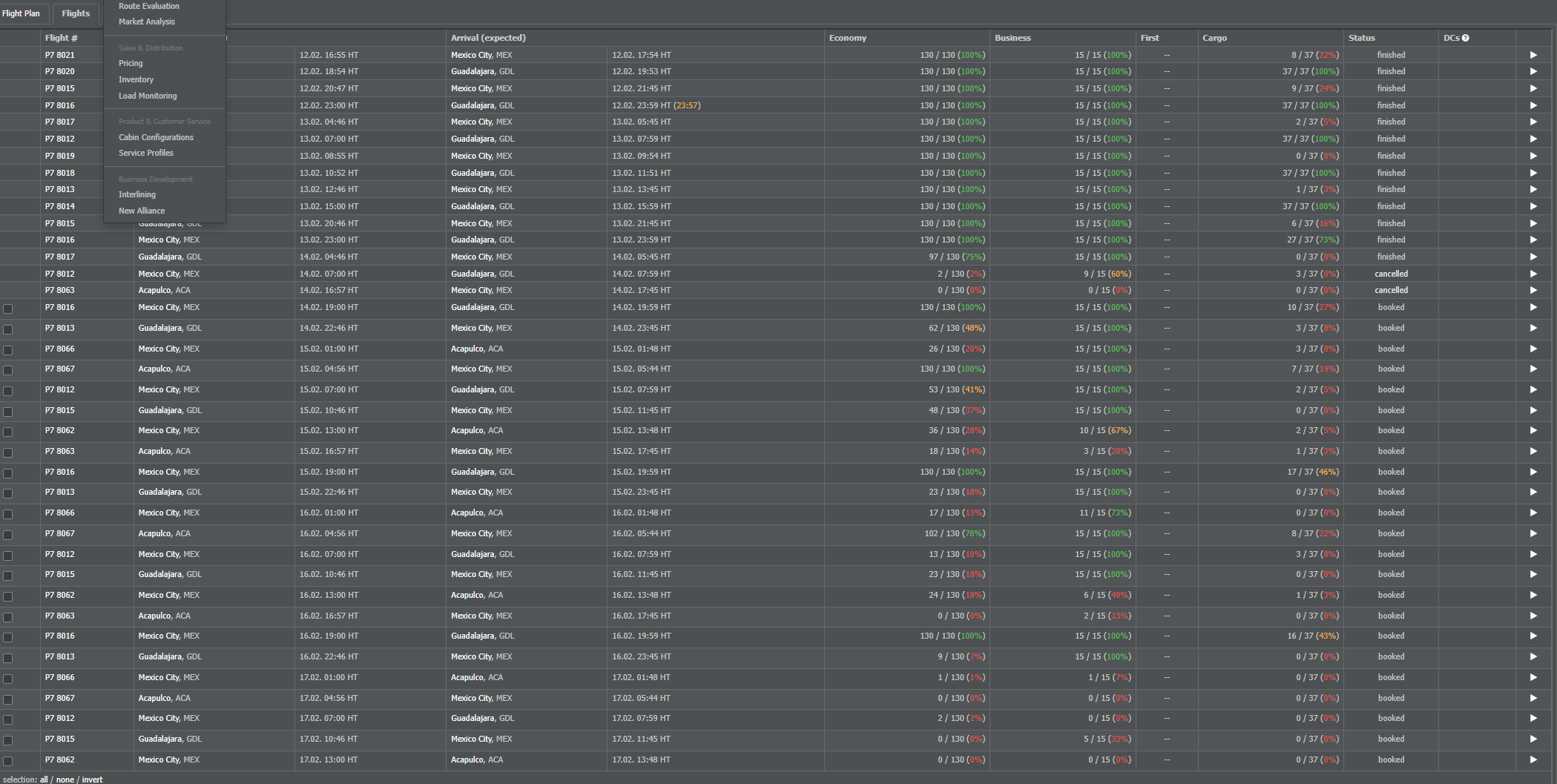
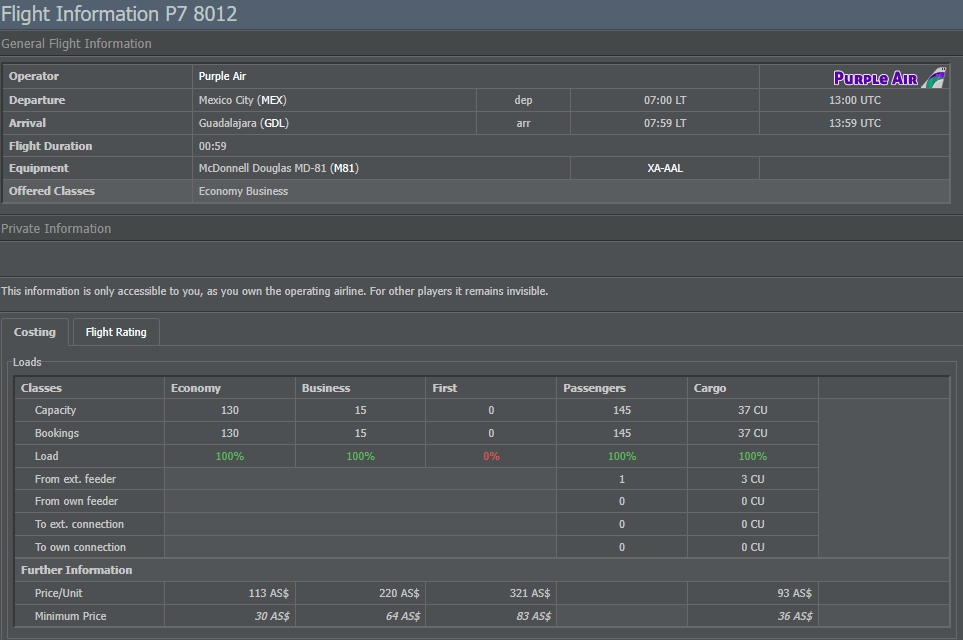
Hello, I didn’t quite understand how this new patch managed to completely “drain” my passenger volume. According to ORS, my product performance actually improved over the past week, but the passengers disappeared. I don’t have any new competitors, and nothing has changed in the MEX–GDL market. Please see the flight comparisons below.